
Lead Acid and Lithium Battery Chargers Guide
Introduction
Lead acid Batteries have undergone significant evolution over recent years to the extent that many old battery chargers are no longer suitable for battery maintenance.
Likewise, Lithium Batteries have evolved and need special conditions for charging although the requirements for both lead acid and lithium can be delivered by the same modern automatic charger now.
Modern chargers use sequential stages to complete the charging cycle in about 12 hours. Calcium (CA) lead acid batteries are now the most commonly used type in today’s cars.
As battery technology has progressed, understanding the differences in charging requirements has become more important. Calcium lead acid batteries, in particular, offer increased resistance to corrosion and improved performance in modern vehicles, but this comes with the need for more sophisticated charging methods. Using an outdated charger can result in incomplete charging cycles, ultimately reducing battery life and reliability. The market offers many makes and models of chargers that can seem daunting, but it is not just sales hype and product differentiation that’s going on here. Local stores such as Repco and Supercheap Auto are worth a look.
Calcium lead acid batteries require specific charging profiles to ensure optimal performance and longevity. Unlike standard lead acid batteries, they often need higher charging voltages and carefully managed stages to avoid undercharging, which would otherwise lead to reduced capacity over time. Selecting an appropriate charger designed for calcium batteries is crucial for maintaining battery health and ensuring reliable operation, especially in vehicles equipped with advanced start-stop technology.
Repco sell a PROJECTA Pro-Charge Battery Charger 8 Amp 6-stage switch mode PC800 ($175) that seems ideal for both occasional charging or for permanent hard wiring to a lead acid car battery.
Lead Acid Battery types
Battery types or “battery chemistry” varies depending upon intended usage and they have different charging requirements.
Examples are:
- Gel Batteries charge at (Charge at 14.4V)
- Lead Acid Wet batteries- traditional lead-antimony alloy (charge at 14.7V)
- Calcium Batteries newer lead–calcium alloy (charging rates must exceed 14.8V up to 16V)
A variation is Silver–calcium alloy batteries. These are a type of lead-acid battery with grids made from lead-calcium-silver alloy, instead of the traditional lead-antimony alloy or newer lead–calcium alloy. They stand out for their resistance to corrosion and the destructive effects of high temperatures. The result of this improvement is manifested in increased battery life and maintaining a high starting power over time. Car batteries do last longer now than they did.
A further variation is the AGM (Absorbent Glass Mat) battery. It is a type of advanced lead-acid battery where the liquid electrolyte is absorbed into a fine glass mat between the battery's plates. This design makes the battery spill-proof, maintenance-free, and more resistant to vibration.
A point to note: Calcium and Silver Alloys: charging rates must exceed 14.8v up to a max of 16v during the charging process to successfully charge these batteries.
Voltage Measurements
Historically, portable power and batteries were based on 2 Volt lead acid accumulator cells often grouped into blocks of six to form a 12V battery. The exact terminal voltage of this battery depends upon its state of charge. As a guide for traditional Lead batteries this was:
| Condition | Voltage |
| Discharged 12V Battery | 12.00V |
| Fully Charged 12V Battery (no load) | 12.5V to 13.2 |
| Vehicle Charging System active | 13.8 to 14.2V |
| Mains based Power supplies | 13.6 to 13.8V |
From this it can be seen as a rule of thumb: If a battery measured 12V it was flat, and if it reads about 13V, it was charged. An accurate meter can be helpful in analysis of lead acid batteries and their charging systems.
It is interesting to observe that Triumph autos and some other British vintage motorcar manufacturers put expanded scale volt meters on the dash of their premium models. A useful indicator of battery state was between 10V – 15V.
A 12V Calcium (CA) Battery requires a charge voltage of 14.4 -14.8V rather than the more familiar range for older lead acid batteries of 13.8 -14.2V.
It is worth noting that measuring voltage is a non-invasive process that can be done without disturbing the circuit or system of interest. Volt meters are relatively high impedance and will not cause any loading to diminish the reading. Cheap digital displays for voltage are brilliant for indicating voltage and lead to practically error free reading for the non-technical compared to the old moving coil analogue meters that require interpretation of the relevant scale.
Multi-stage Automatic Battery Chargers
Web searching will reveal plenty of examples and differences between models of chargers to choose from. The idea is to select a model most suited to your particular situation.
Some models will cope with both Lead Acid and Lithium batteries. A typical description of an automatic seven -stage Lead Acid and a five-stage Lithium charger combination appliance follows:
Lead Acid Seven Stage Automatic Charging
(GEL, AGM, WET & Calcium)
This charger incorporates technology to deliver a 7-stage charge suitable for automotive, calcium, marine and all types of deep cycle batteries (Gel and AGM). These stages of charging ensure maximum battery life and performance are delivered with a faster charging time and ensure a complete charge is achieved.
The 7 charge stages are:
Desulphation; Soft Start; Bulk; Absorption; Analysis; Recondition and Float.
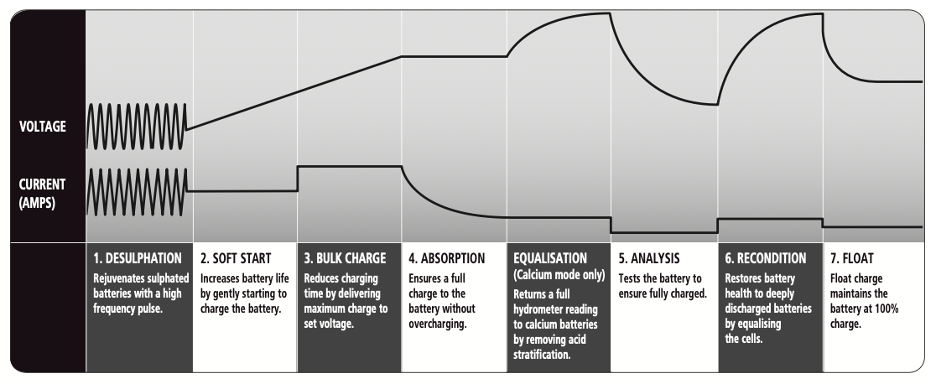
1. DESULPHATION
The Desulphation stage is designed to break down sulphation occurring in batteries that have been left flat for extended periods of time, returning them back to full charge. Sulphation occurs when lead-sulphate hardens and clogs up the battery cells.
2. SOFT START
This is a preliminary charge process that gently introduces power to the battery, protecting the battery and increasing battery life.
3. BULK (CONSTANT CURRENT)
The Bulk stage reduces charging time by charging the battery at the maximum rate (constant current) to a set voltage, at which point the battery is approximately 80% charged.
4. ABSORPTION (CONSTANT VOLTAGE)
The absorption stage charges the battery to 100% by adjusting the charge rate allowing the battery to absorb more power.
EQUALISATION (CALCIUM MODE ONLY)
Designed especially for calcium batteries, this additional stage returns calcium batteries to full service by removing acid stratification of the electrolyte.
5. ANALYSIS
The analysis mode tests the battery to ensure that it has taken the charge. If the battery passes the test, the charger will proceed to the float stage, but if the battery fails the test, the charger will apply a recondition charge to try to return the battery to full charge.
6. RECONDITION
If after charging, the battery is unable to hold the charge the battery reconditioning function is initiated automatically. This is most likely to take place on batteries that have been deeply discharged, prior to charging. The Recondition mode will then run for 4 hours and at the end will retest the battery. The Intelli-Charge battery charger will perform the recondition charge up to 3 times before switching the charging cycle to Float with an error indication.
7. FLOAT
The Float stage maintains the battery at 100% charge without overcharging or damaging the battery. This means the charger can be left connected to the battery indefinitely.
Five Stage Lithium Automatic Charging
When the Lithium Profile is selected, Intelli-Charge utilises a very specific and tailored 5 stage charging algorithm, engineered to get the best out of today’s Lithium (LiFePO4) batteries.
The 5 lithium charge stages are:
Soft Start 1; Soft Start 2; Bulk Charge; Absorption and Float.
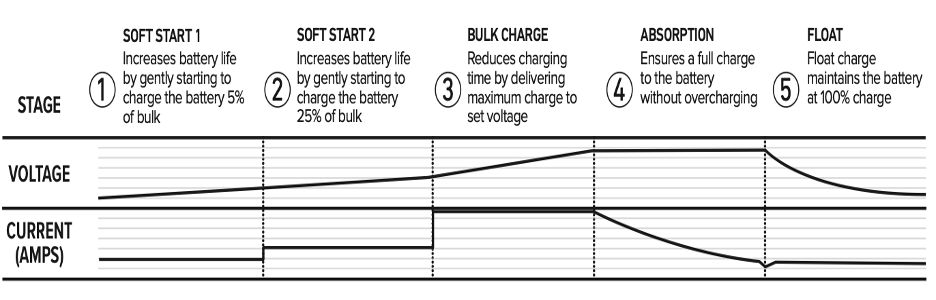
Soft Start 1
Increases battery life by gently starting to charge the battery 5% of bulk.
Soft Start 2
Increases battery life by gently starting to charge the battery 25% of bulk.
Bulk Charge
Reduces charging time by delivering maximum charge to set voltage.
Absorption
Ensures a full charge to the battery without overcharging.
Float
Float charge maintains the battery at 100% charge.
Battery Chemistry Selection
The Multi-Chem function allows the charging profile to be set for each battery’s chemistry type (Lithium, GEL, AGM, WET and Calcium). This ensures correct and thorough charging and maximises battery performance and battery life. This may be a manual or automatic selection depending upon the make and model of the charger. The following section describes the charge profiles for each chemistry type.
POWER SUPPLY (CONSTANT VOLTAGE OF 13.8 VOLTS)
This sets the charger in power supply mode giving a constant voltage of 13.8VDC. This mode is best used where appliances are drawing power from the battery, for example a Fridge.
LITHIUM (MAX VOLTAGE OF 14.2 VOLTS)
Charger will use a lithium-specific 5 stage charging algorithm.
GEL (MAX VOLTAGE OF 14.1 VOLTS)
This charge mode is designed for GEL batteries and has a maximum charge voltage of 14.1V. Note that some GEL batteries require a higher charge voltage such as 14.4V. The AGM mode can be used if this is required.
AGM (MAX VOLTAGE OF 14.4 VOLTS)
This charge mode is designed for AGM batteries and has a maximum charge voltage of 14.4V.
WET (BULK AND ABSORPTION 14.7 VOLTS, RECONDITION UP TO 16 VOLTS)
This charge mode is designed for WET batteries and has a maximum charge voltage of 14.7V during Bulk and Absorption stages and 16.0V during the Recondition stage.
CALCIUM (BULK AND ABSORPTION 14.7 VOLTS, EQUALISATION AND RECONDITION UP TO 16 VOLTS)
This charge mode is best suited for Calcium batteries that have been deeply discharged and require an equalisation charge to restore a full electrolyte reading. If the battery requires a simple ‘top-up’, the WET charge mode can be used.
Terminal Voltage Measurements
As described above, the terminal voltages on the batteries will depend upon the Chemistry used. The following is an example of the measured behaviour during a 14 hr charging cycle of a Calcium lead acid battery being charged
Charger: Calibre Brand, model PC 10.
Vehicle: BMW - X3
Battery type: Calcium for a car with start-stop technology
| Time | Current | Voltage | Notes |
| 17:00 | 10 A | 13.5V | Initial period |
| 19:30 | 3.5 A | 15.58V | Bulk charge Stage |
| 21:15 | 2.5A | 15.56V | |
| 21:45 | 2.5A | 15.63V | |
| overnight | |||
| 7:00am | 1A | 13.77V | Float charge stage (after 14hrs) |
Application for Radio Systems
Old simple chargers should be scrapped to prevent unsafe use, and new chargers will ensure batteries have much longer life if regularly maintained.
When used in radio systems, battery chargers play a crucial role in maintaining reliable operation, particularly for equipment that requires continuous power supply. Ensuring that batteries remain fully charged helps prevent unexpected downtime and supports consistent communication performance. Proper charger selection and regular maintenance are essential to maximise the lifespan of the batteries and safety the radio systems they support.
Conclusion
Modern Battery chargers are not simple devices any more. Some care and attention is needed to ensure the correct type of battery charger is used for the different battery types.
Reference to the manufacturer's guidelines for both the battery and chargers to optimise efficiency and to ensure safety is recommended.
It is quite likely if you have a old trusty charger it is now not fit for purpose and should be dumped and replaced with a new one.
Bernard Robbins ZL2BD
November 2025