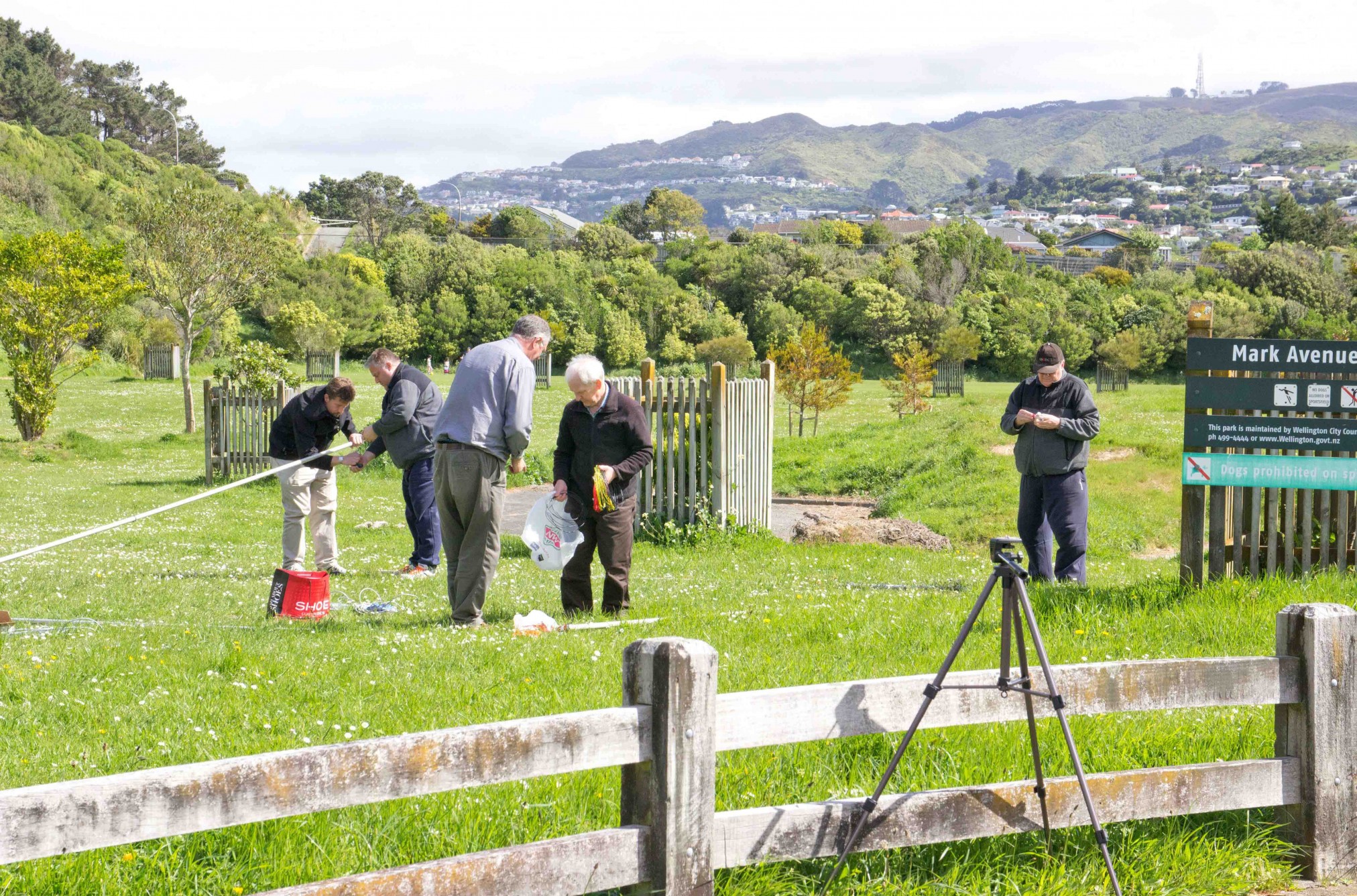
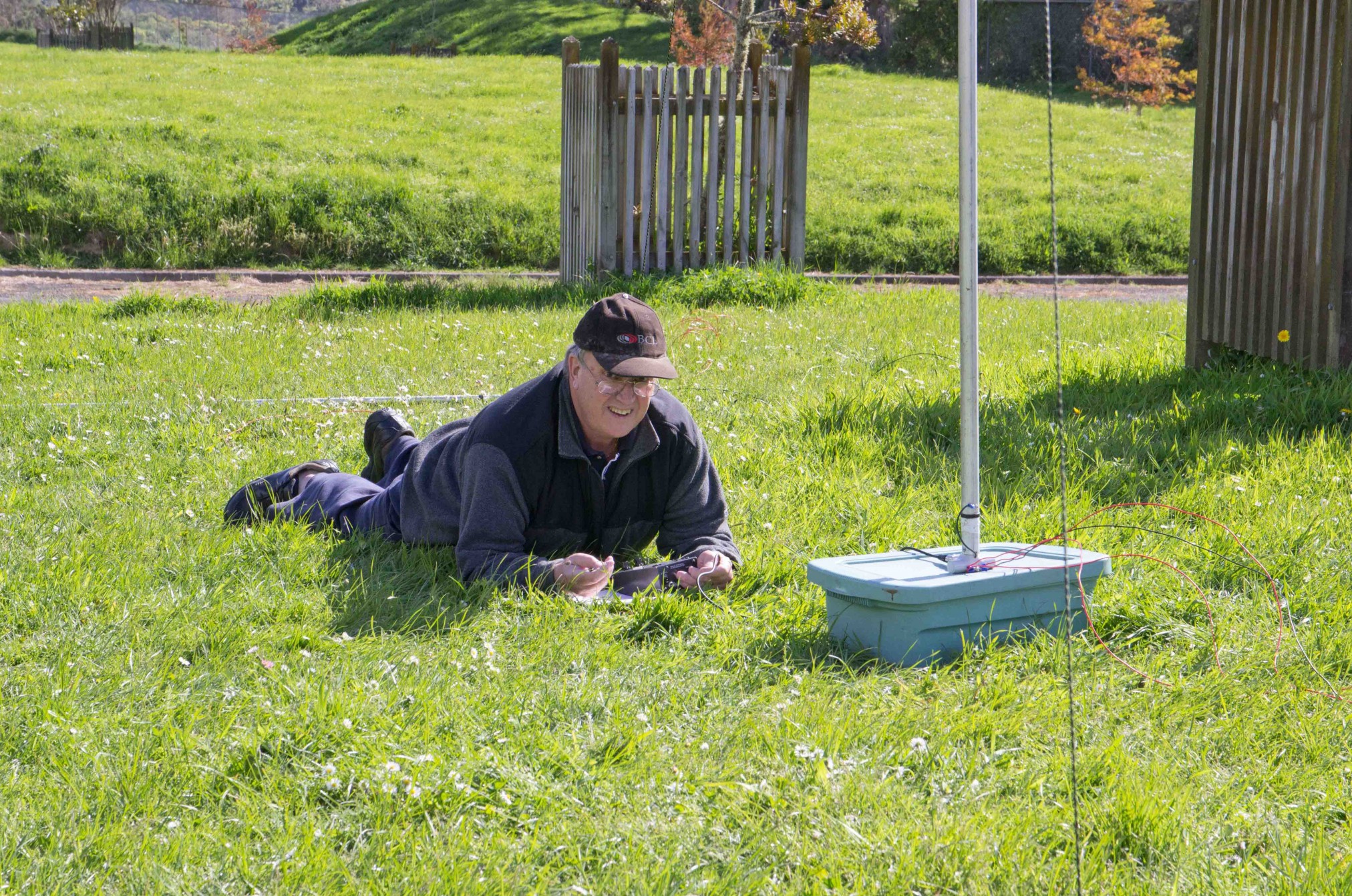
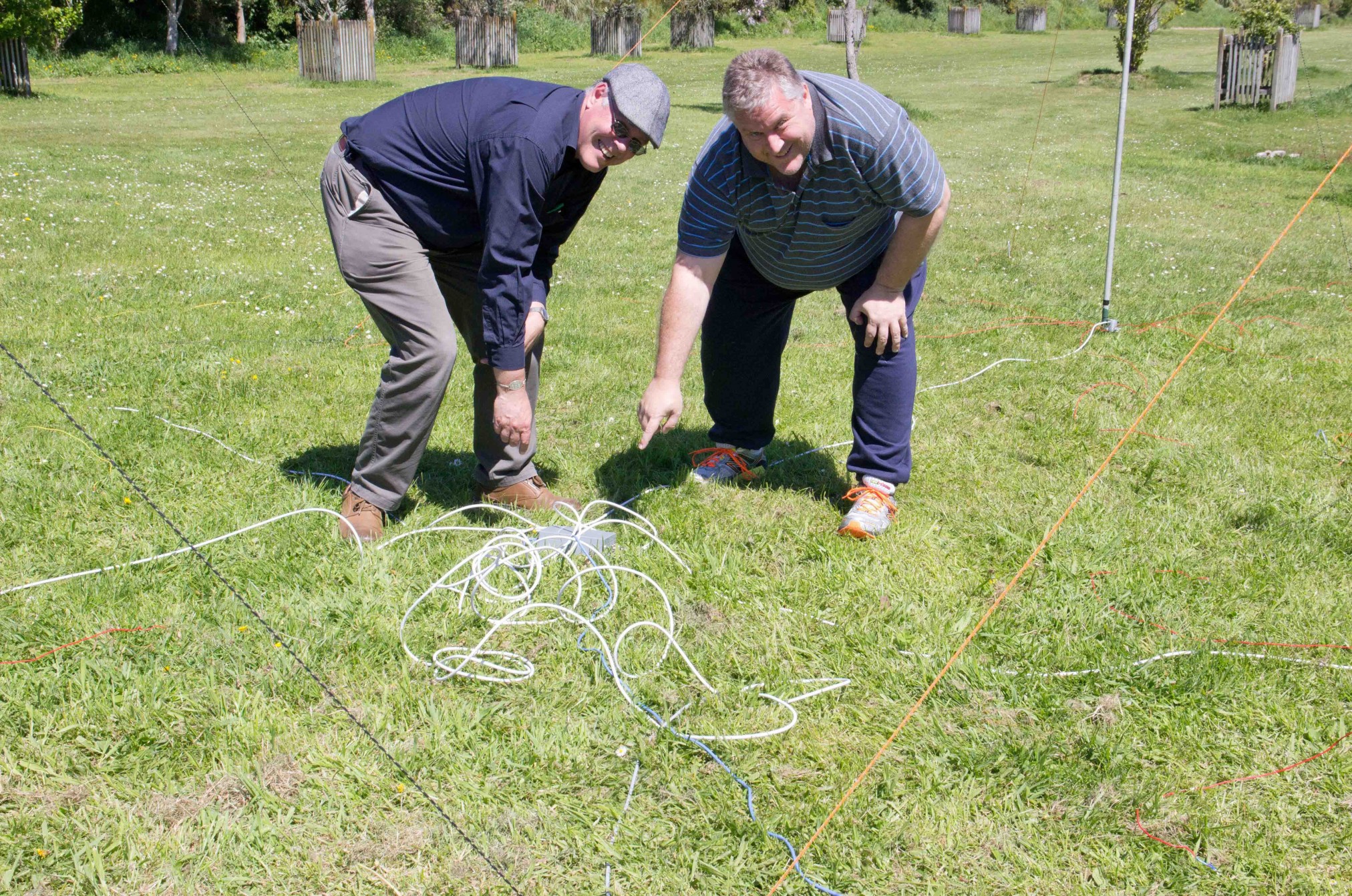
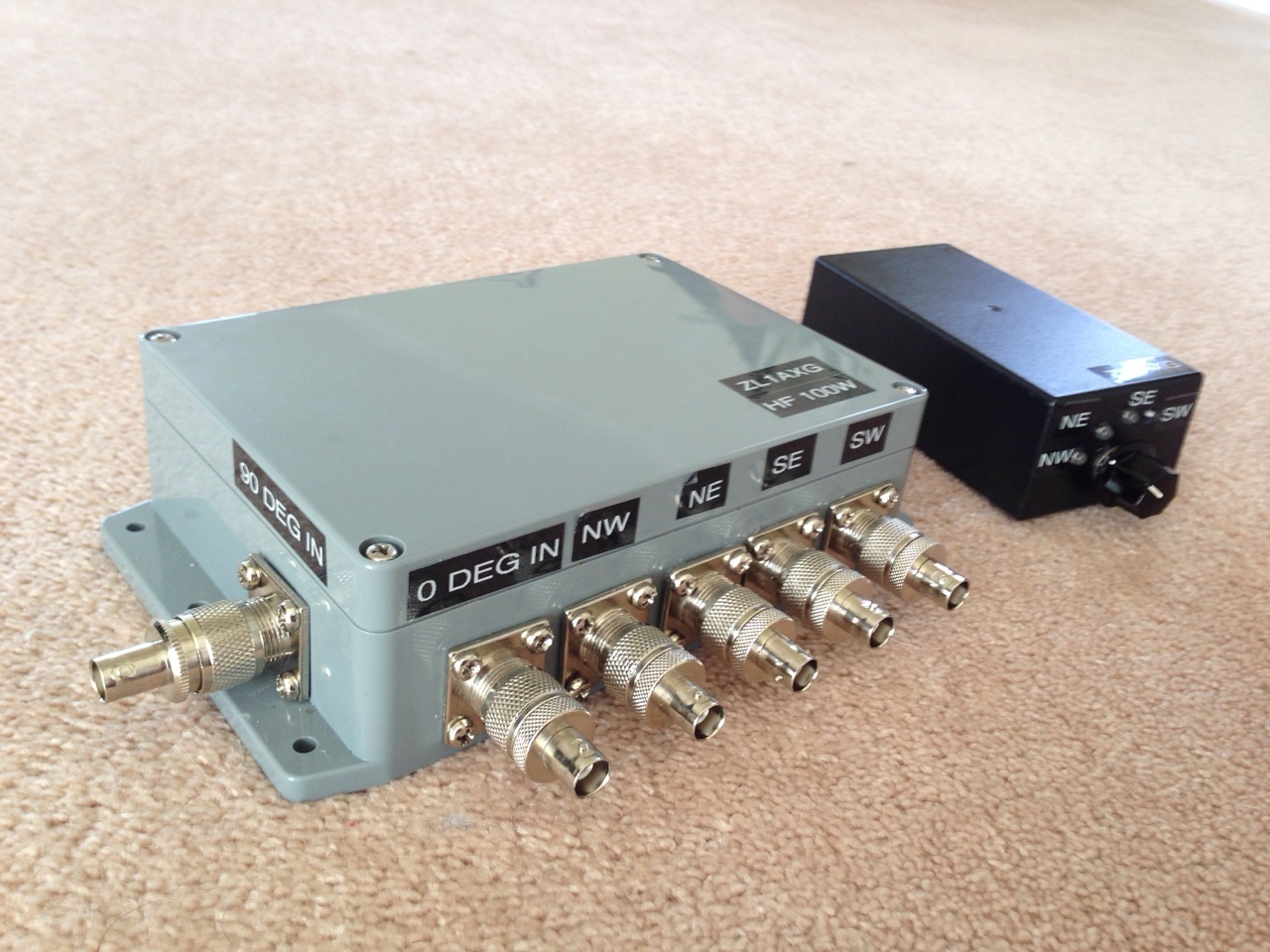
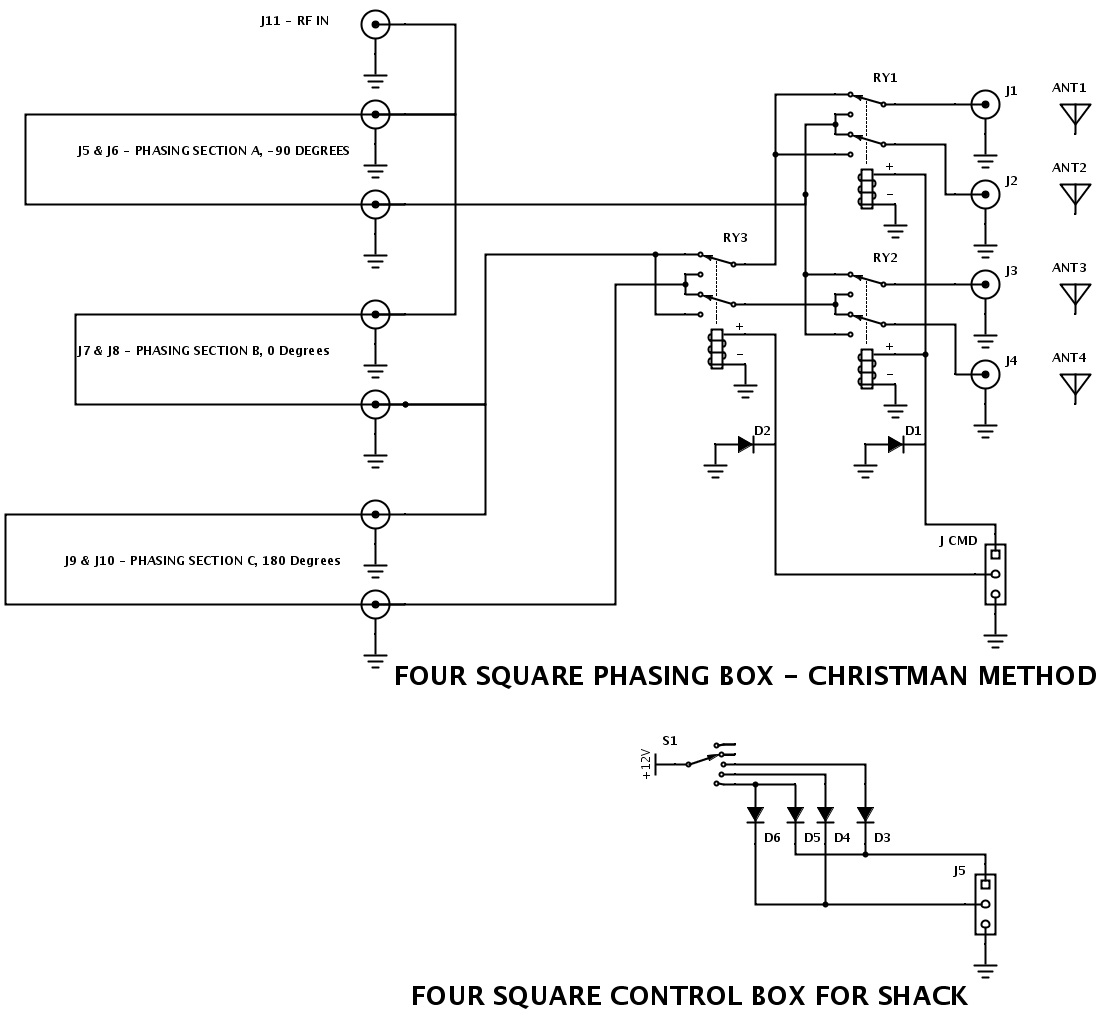
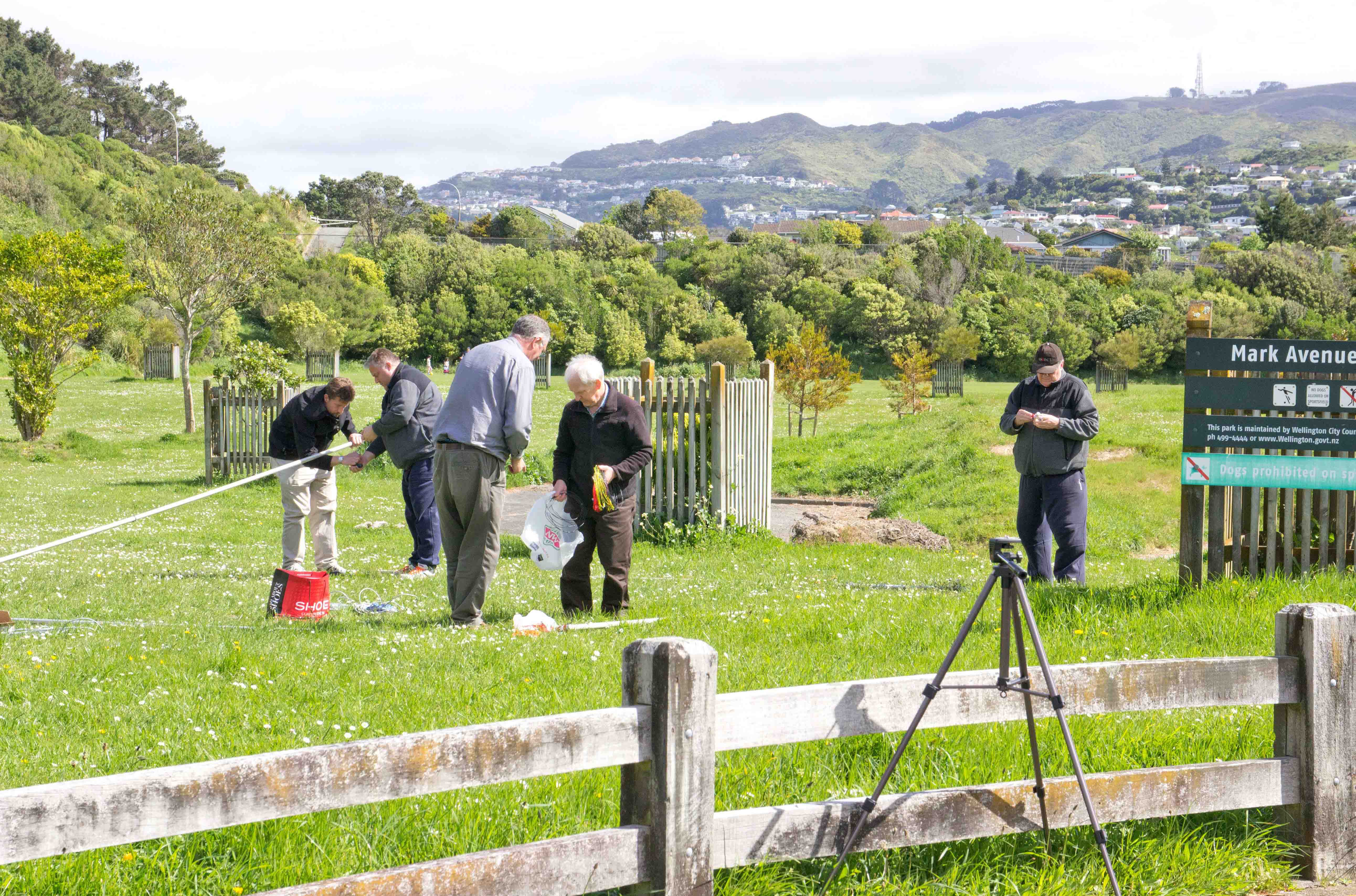
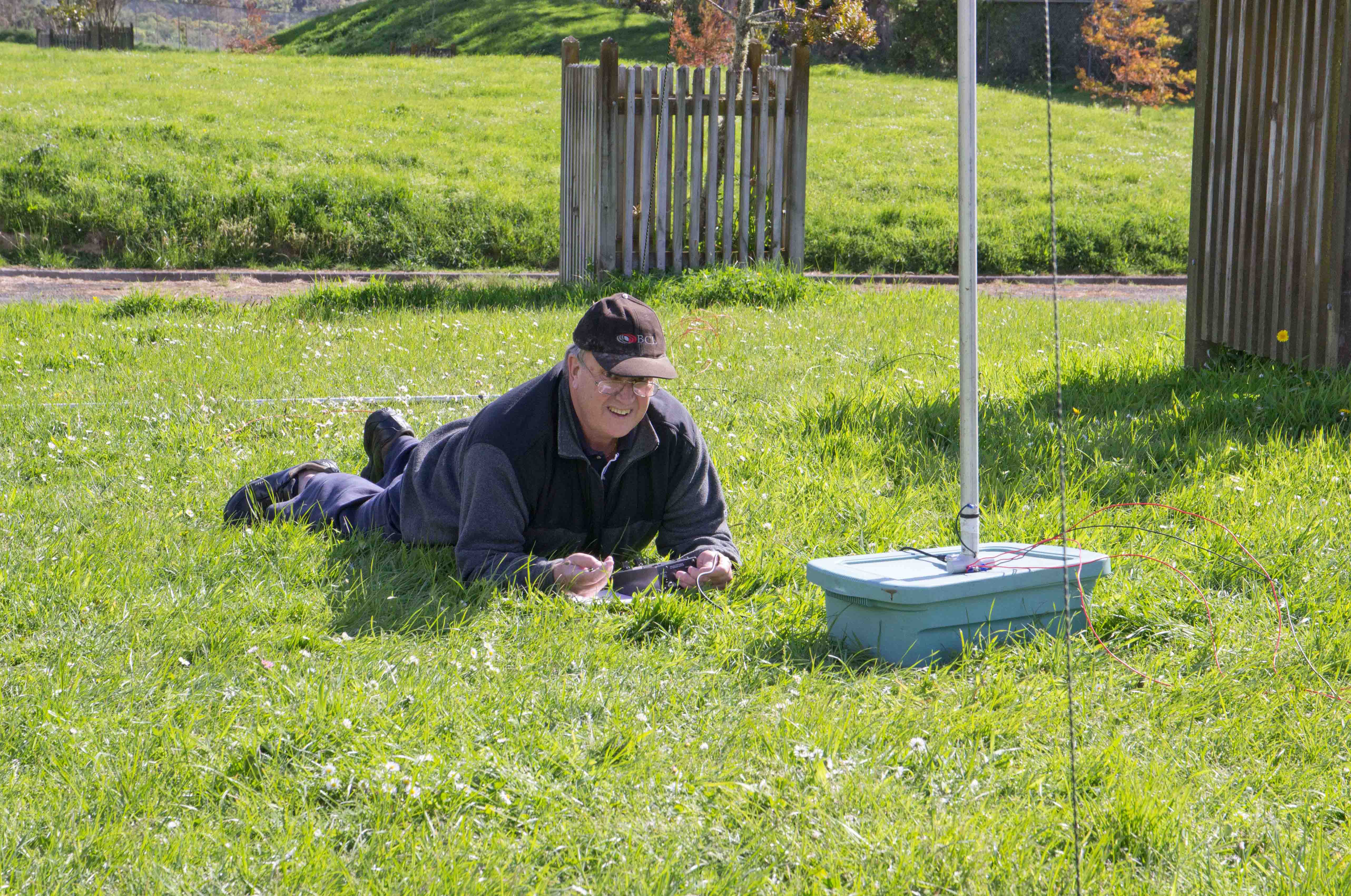
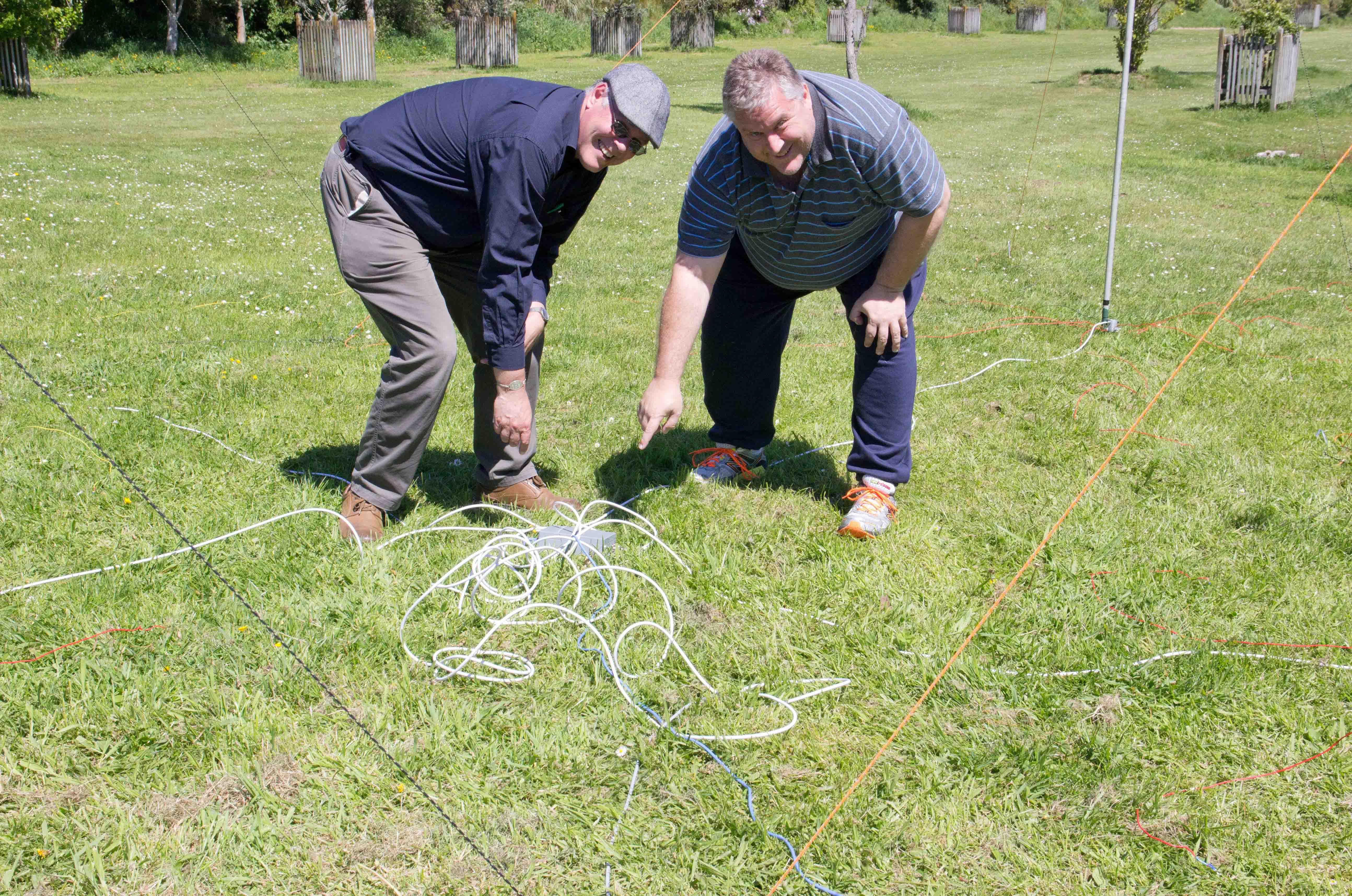
by Mike ZL1AXG A four square antenna has now been built and assembled, assisted by a number of local amateurs (Doug ZL2AOV is photographer, Bernard ZL2BD, James ZL2ET, flatmate Josh, and Malcolm ZL2UDF and myself are in assembly mode). Full testing wasn't possible because 20m at the test location in Grenada Village was full of local QRN at S6+ and peaking over S9. It did, however, pull in stations on 15m, even if it was not designed for that band! The team are busy assembling the portable four square array for 20m. The array takes about an hour to assemble: four antennas, four feedlines, a control box, coax and an ethernet line back to the rig and remote control, and 32 radials! Bernard ZL2BD measuring the impedance at the feedpoint with his antenna analyser. Note that we found in this first test that the initial feed arrangement wasn't satisfactory, creating too much coupling to ground. Doug reworked the "feet" giving them nice painted toenails (in British racing green). I started this project with the intention of engendering interest in phased vertical arrays. I imagine that the club will get to play with this antenna (and hopefully others like it) in our annual efforts in Oceania DX Contest and CQ WW contests. 20m was picked as a starting band because element lengths are manageable (approx. 5m). If there is a band where your signal needs to stand out in a contest then it would be 20m! A four square has around 5.5dB of gain over a monopole, similar to a horizontal beam antenna. However, all assembly is done on the ground, there is no rotator and it is very quick to switch directions. What a tiny box! James ZL2ET and Mike ZL1AXG can be seen pointing at the controller. You can spot the 1/4 wave current forcing 75 ohm feed-lines from the controller box to each monopole. The control box and remote unit The controller is not frequency dependent - containing only switching equipment (3 DPDT relays) and a broadband transformer. To get the 90 degree offset for the centre radiators you use two pieces of coax, in a Christman matching arrangement. The lengths are calculated using a computer program downloadable from W7EL's website at EZNEC.com. You simply input the impedances of the component monopole antennas measured using an antenna analyser, the configuration of the array, frequency and velocity factor of the coax. Out pops the lengths of coax to be cut in metres. The program solves two complex number calculations behind the scenes. Simple! The two pieces of 75 ohm coax (one is 2.395m long, the other is 7.799m long) are joined together with a Tee connector creating a common voltage feedpoint where they are fed with 50 ohm coax (grey RG8U) from the rig. These feeders plug into the controller, giving 0 (rear element) and 90 degrees (centre elements) of phase difference. The 180 degree shift (front element) is achieved using a broadband transformer constructed on a FET240 type 43 ferrite toroid sourced from SICOM Ltd. I am working on constructing a hybrid coupler as well, in order to compare the different feed arrangements. Hybrid couplers are frequency specific as they contain both inductance and capacitance. They are popular in commercial units as they are not as sensitive to the antenna feedpoint impedance. Some say they are more lossy than Christman feed. We shall see! A special thanks to Malcolm ZL2UDF who provided the aluminium tubing for the four antennas (ex Quartz Hill 20m beam), Bernard for assistance in calculating the 1/4 wavelength feeder lengths and velocity factor of the 75 ohm coax and supplying the antenna analyser, and Doug ZL2AOV who reworked the "feet" and connection mechanisms for the antennas, and resolved the resonance issue so that they tuned up properly. At the next club meeting on Wednesday 19 November at 7.30pm, you will hear me talk a bit more about phased vertical arrays in general. I will discuss why these arrays make sense for contesting, basic configurations (2, 3, 4 or more elements), switching and feed arrangements. I will also cover off practical design ideas for both this portable four square and my as yet unfinished two element multi-band array under construction.
On 17 January we gathered at Mike ZL1AXG's QTH from 12 noon for a summer lunchtime BBQ. XYLs and family members were invited. It turned out to be excellent weather. We were able to share stories of summer adventures (particularly the acquisition of new radio gear from a Christmas estate sale) and chat about the club's future with the upcoming Hamcram.
How do you know whether a band is open? There are a number of different ways to know if there is propagation on an HF band. Listening for stations on a band is not necessarily the best way to determine whether there is a band opening. If everybody is listening, and nobody is calling then the band will still seem to be dead. John ZL2XJ and Mike ZL1AXG demonstrated the use of beacons, DX clusters, the reverse beacon network, WSPR that can all help in determining the likelihood of a band being open. The QTH for the Shed Workshop held on 1 August 2021 was that of John ZL2XJ at 9 Ridley Green, Churton Park. [wpdm_package id='4781'] [wpdm_package id='4777'] [wpdm_package id='4779']
Out came the steaks, chops, chicken kebabs, salads, and cake at the annual summer BBQ at the QTH of club chairman, Mike ZL1AXG, on 20 January 2016. Attendance was similar to previous years, but several XYLs came along for the first time. Please note that the February and March meetings are on the 3rd Tuesday, NOT on the Wednesday as per usual.